ASUS TUF Gaming A16 FA608UM Analysis: RTX 5060 Value
The Blunt Verdict
The ASUS TUF Gaming A16 FA608UM is a serious gaming machine at a non-serious price point. If you want an RTX 5060 laptop that won’t require a second mortgage, this is where you look first. It pairs AMD’s latest Ryzen silicon with Nvidia’s newest mobile GPU generation in a chassis that weighs just 2.2kg — which for a 16-inch gaming laptop is genuinely respectable. The headline weakness? Fan noise under load is real, one buyer had a unit with a grinding fan and had to return it, and the sample of reviews is still thin enough that a reliability pattern hasn’t fully emerged yet.
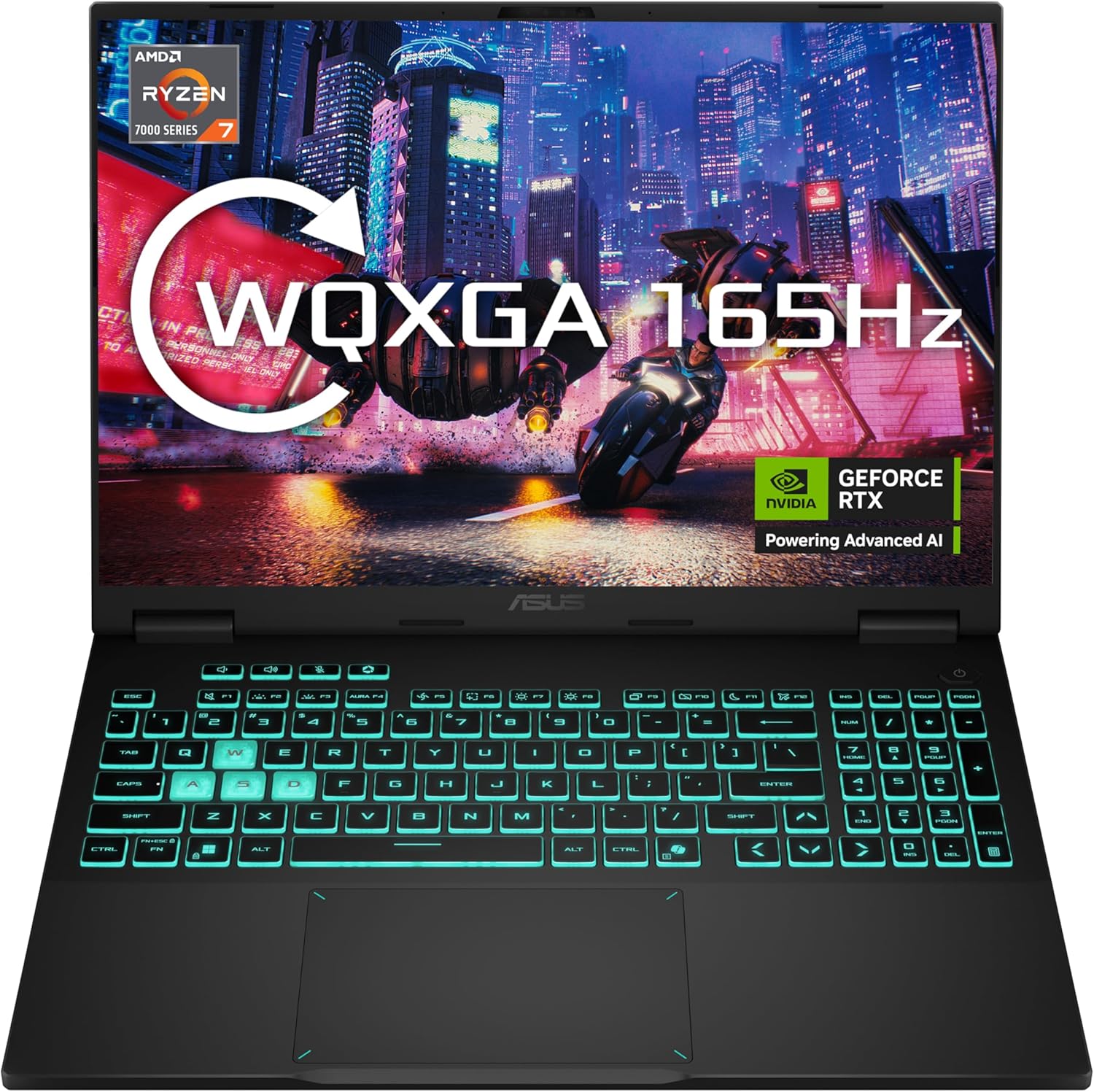
The key specs here are worth unpacking. You get an AMD Ryzen 7 260 processor, 16GB of DDR5 RAM, a 1TB PCIe SSD, and an NVIDIA GeForce RTX 5060 Laptop GPU driving a 1920 x 1200 165Hz panel with a 16:10 aspect ratio. That GPU is a big deal — RTX 5060 mobile is built on Nvidia’s Blackwell architecture with DLSS 4 support, which is the current generation at the time of writing. You’re not buying yesterday’s tech dressed up with a new sticker. The 90Wh battery is also larger than most competitors in this segment bother to fit.
Buy it if you want a capable gaming laptop that punches above its class on raw GPU grunt and you’re comfortable accepting some fan noise and a relatively thin initial review pool. Avoid it if you need something whisper-quiet for office environments, or if you’re hoping to do most of your work on battery power — gaming laptops and all-day battery life are fundamentally at odds, regardless of what the marketing implies. If you’re still weighing your options more broadly, our laptop buying guide covers the decisions you need to make before committing.
See the current listing for the ASUS TUF Gaming A16 FA608UM before reading on.

Pros and Cons
Pros
- RTX 5060 Laptop GPU is current-generation Blackwell architecture with DLSS 4 — not a rehashed previous-gen card
- 16:10 aspect ratio on the 165Hz panel gives more vertical screen space than 16:9 competitors, genuinely useful for gaming and everyday work
- 90Wh battery is large for a gaming laptop in this class — won’t save you during a six-hour gaming session but buys more flexibility for lighter tasks
- DDR5 RAM and PCIe Gen 4 SSD mean storage and memory aren’t a bottleneck — the GPU won’t be sat waiting on slow system components
- 2.2kg weight and 17.9mm thin profile make this more manageable to carry than most gaming laptops with comparable GPU specs
- Buyers consistently describe the chassis as sturdy and the keyboard as good — both matter for day-to-day confidence in a machine you’re lugging around
Cons
- Fan noise under full gaming load is loud — one buyer described it as a “jet engine,” and that’s consistent with what you’d expect from a thin chassis pushing RTX 5060 power levels
- One returned unit had a grinding, clicking fan — isolated or early production issue, but worth monitoring as more reviews come in
- Wi-Fi is listed as 802.11ac (Wi-Fi 5) — for a 2025 gaming laptop, the absence of Wi-Fi 6 is a step behind where competitors are sitting
Spec Breakdown
- Model: ASUS TUF Gaming A16 FA608UM
- CPU: AMD Ryzen 7 260, up to 5.1GHz, 8-core / 16-thread
- RAM: 16GB DDR5 (expandable to 32GB)
- Storage: 1TB PCIe Gen 4 SSD
- GPU: NVIDIA GeForce RTX 5060 Laptop GPU (GDDR6)
- Display: 16.0-inch, 1920 x 1200, 16:10, 165Hz, LED
- Battery: 90Wh, Lithium Ion
- OS: Windows 11 Home
- Weight: 2.2kg
- Ports: 4x USB total; HDMI output; USB Type-C; RJ-45 (Ethernet)
- Connectivity: 802.11ac Wi-Fi; no Bluetooth listed
- Webcam: None
- Extras: 3 months Xbox Game Pass; NVIDIA G-SYNC; DLSS 4; NVIDIA Studio
Hardware & Performance Reality Check
The AMD Ryzen 7 260 is a current-generation chip built for laptop efficiency without sacrificing thread count — 8 cores and 16 threads, boosting to 5.1GHz. In daily use that means fast application launches, smooth multitasking, and no frustrating waits during compilation or photo exports. For those less familiar with what processor specs actually mean in practice, the CPU guide is a useful primer. The 16GB DDR5 RAM is the right amount for gaming in 2025 — enough headroom for a game running alongside Discord, a browser, and background apps. Crucially, ASUS lists the maximum RAM as 32GB, which suggests at least some slots are user-accessible. That’s not a given on a machine this thin, and it meaningfully extends the useful life of the hardware. If you’re uncertain how much memory you actually need, this breakdown on how much RAM you need is worth five minutes of your time.
The 1TB PCIe Gen 4 SSD is fast enough that load times in modern games won’t be the bottleneck — you’re getting one of the faster storage interfaces available. A terabyte is adequate for most people, but if you’re planning to install a large library of modern AAA titles simultaneously, you’ll feel the squeeze eventually. The star of the show here is the NVIDIA GeForce RTX 5060 Laptop GPU, Nvidia’s Blackwell-generation card with GDDR6 memory. This is a genuine step up from the previous RTX 4060 mobile, especially with DLSS 4’s frame generation improving perceived smoothness significantly. At the native 1920 x 1200 resolution on a 165Hz panel, this GPU has every chance of keeping frame rates high enough to make that refresh rate count in most titles. For a broader look at what GPU and display specs actually translate to in practice, our performance benchmarks guide has context worth reading.
For real-world use in 2026 and beyond: student work and office tasks are effortless for this hardware — that’s not even a question worth asking. Programming workloads, including compilation and running local servers, sit comfortably within the Ryzen 7’s wheelhouse. Gaming at the native resolution is where this machine is designed to operate, and the RTX 5060 with DLSS 4 engaged should handle most current titles at high settings. Video editing in Premiere or DaVinci Resolve benefits directly from GPU acceleration, and the RTX 5060 handles that well. The one caveat: sustained heavy workloads will push the fans hard, which is the trade-off for squeezing this much GPU into a 17.9mm chassis.
One hardware flag worth raising separately: the spec sheet lists 802.11ac Wi-Fi, which is Wi-Fi 5. That’s not a dealbreaker, but on a gaming machine where latency matters, it’s a bit behind where you’d expect a 2025 laptop to land. Wi-Fi 6 has been standard on gaming laptops for a couple of years now. If you’re connecting via the RJ-45 Ethernet port — which you absolutely should be for serious gaming — it doesn’t matter at all. If you’re relying solely on wireless, it’s worth factoring in. The port situation overall is covered well enough: HDMI out, USB Type-C, Ethernet, and four USB ports total. Full port context is in our ports guide if you need to check compatibility with your setup.
Check the full spec sheet and buyer Q&As for the ASUS TUF Gaming A16 FA608UM.
Everyday Usability: Battery, Build & More
The 90Wh battery is one of the better-specced cells you’ll find in a gaming laptop at this level. Under light use — documents, video playback, browsing — you can expect a reasonable stretch of unplugged time. Under gaming load, forget it; you’ll want the charger in the wall. That’s not a criticism specific to this machine, it’s just physics — the RTX 5060 pulls significant power when it’s working. The chassis measures 35.4 x 26.9cm and 17.9mm at its thinnest, which puts it in genuinely manageable territory for a 16-inch gaming machine. At 2.2kg it’s not light in the way an ultrabook is light, but it’s lighter than most direct gaming competitors with comparable specs. Buyers have described the build as sturdy, and the TUF Gaming line has a reasonable reputation for chassis rigidity — ASUS leans into the military-grade durability angle, which is partly marketing, but the physical feedback from buyers here supports at least the basic claim.

The 165Hz display with its 16:10 ratio is one of the genuine highlights of this package. Buyers have called out screen quality specifically — “amazing” is one word used. The wider aspect ratio gives you more vertical real estate than the standard 16:9 widescreen format, which helps both in games with tall UI elements and in day-to-day work tasks like coding or document editing. The display is listed at 300 nits brightness, which is fine indoors but won’t win any awards next to a window in direct sunlight. No touchscreen — this is a clamshell gaming machine and that’s entirely appropriate here. For a deeper look at what display specs actually mean day-to-day, the display types guide is worth a read. On noise: under heavy gaming load the fans are loud. One buyer’s “jet engine” description is colourful but not inaccurate for this type of machine. With headphones on, as that same buyer noted, it’s a non-issue. The keyboard gets positive mentions — described as beautiful by one buyer — and the G-SYNC integration on the display means you should get clean, tear-free gaming without needing to manually cap frame rates. There is no webcam, no fingerprint reader listed, and Bluetooth is absent from the spec sheet — if any of those matter to you, factor them in.
Lifespan & Future-Proofing
On chassis longevity: the TUF Gaming line has a track record of holding together over multiple years of regular use. ASUS’s military-grade testing claims are partly marketing shorthand, but the physical build quality feedback from buyers — sturdy chassis, no flex complaints — is consistent with what the TUF line has delivered historically. Realistically, if you don’t abuse it, the physical machine should hold up for five or more years. The 1-year manufacturer warranty is standard and nothing to get excited about, but it’s the baseline you’d expect.
On spec longevity: this is where the ASUS TUF Gaming A16 FA608UM holds up well relative to its competition. The RTX 5060 Laptop GPU is current-generation Blackwell architecture, and with DLSS 4 frame generation available, it has meaningful headroom before it feels dated for gaming. By 2026 this GPU is already current; realistically it stays relevant for gaming at 1080p and 1200p for at least three to four years from now, possibly more with upscaling doing the heavy lifting. The DDR5 memory and PCIe Gen 4 storage are modern standards that won’t need replacing. The potential RAM upgrade path to 32GB extends the machine’s viable lifespan further. The Wi-Fi 5 situation and the absence of Bluetooth are the only genuine future-proofing concerns — neither is fatal, but both are behind where the market has moved. For those evaluating this against more established options, our roundup of serious gaming laptops provides useful comparison context.
Check current stock and availability for the ASUS TUF Gaming A16 FA608UM.
What Buyers Are Saying (And Potential Dealbreakers)
This machine currently holds a rating of 4.5 out of 5 from 13 reviews on Amazon UK. That’s a positive signal, but 13 reviews is a genuinely small sample — not enough to draw firm conclusions about reliability patterns or long-term ownership experience. Take the sentiment as directionally useful rather than statistically robust. The picture should become clearer as more buyers receive and live with the machine over the coming months.
What the existing reviews do tell us: buyers are broadly pleased with the performance-to-price ratio, the build quality, and the display. Gaming performance is described as smooth, and the chassis and keyboard get specific praise. The one notable negative is a single unit returned due to a grinding, clicking fan — this could be an isolated manufacturing defect, or it could be an early signal worth watching. On a machine with a thin thermal design pushing this level of GPU power, fan issues are always worth monitoring in the early review period. No other mechanical complaints surface in the current pool.
For budget gaming laptops, the common pitfall is compromised display quality or slow storage paired with a capable GPU — neither appears to apply here. The specs explained guide can help you cross-reference what you’re seeing in the listing against what actually matters.
Buyer Highlights
“I’ve been an ASUS laptop user for over 10 years and this is a worthy replacement — gaming performance is really smooth.” — Long-term brand loyalty backed by a decade of direct comparison.
“At full capacity it becomes a jet engine for noise, but with my headset I can barely hear it.” — Relevant if you game without headphones in shared spaces.
“The screen quality is amazing and it is very snappy.” — Display and system responsiveness are the two things buyers notice immediately.
“Amazing power and quality build — beautiful keyboard, and very sturdy chassis.” — Physical build confidence is consistent across multiple buyers.
“The fan kept clicking and grinding so I had to return it — such a shame because I got such a good deal.” — One confirmed return for a mechanical fan defect; worth keeping in mind during the initial ownership period.
Who Should Buy It (And Who Shouldn’t)
Buy If
- You want current-generation GPU performance without paying flagship prices — the RTX 5060 Laptop GPU with DLSS 4 is genuinely modern hardware
- You game at 1080p or 1200p and want a 165Hz display that can actually be fed by the GPU driving it
- You need a machine that can handle photo editing, video work, or programming alongside gaming — the Ryzen 7 and DDR5 RAM handle mixed workloads comfortably
- You’re planning long-term ownership and want upgrade headroom — the 32GB RAM ceiling and PCIe Gen 4 storage mean this machine has room to grow
Avoid If
- You need all-day battery life away from a power socket — gaming laptops running RTX 5060 silicon are not built for that, regardless of the 90Wh cell
- You rely on Bluetooth peripherals or need a webcam built in — both are absent from this machine, so factor in the cost of dongle solutions
- You’re risk-averse about early-batch hardware — the review pool is still thin enough that a mechanical reliability verdict isn’t possible yet; if that matters, waiting a few months for more data is reasonable
The Bottom Line
The ASUS TUF Gaming A16 FA608UM gets the fundamentals right where it counts: current-generation GPU, fast RAM and storage, a display that matches the hardware feeding it, and a chassis that buyers consistently describe as solid. The fan noise is real but manageable with headphones, the Wi-Fi 5 is a minor step behind, and the small review pool means reliability is still an open question. If you’re after a capable gaming machine with genuine longevity in its GPU tier and you can plug into Ethernet for serious sessions, this earns a straightforward recommendation. Those weighing it against alternatives in the wider market will find useful comparison context in our mid-range laptop roundup.
Read the latest buyer Q&As for the ASUS TUF Gaming A16 FA608UM.
At LaptopAdvisorOnline, our methodology is built on data transparency rather than simulated hands-on testing. We rigorously analyse official manufacturer specifications and aggregate verified customer sentiment to provide objective, fluff-free buying advice that helps you cut through the marketing jargon.
As an Amazon Associate, I earn from qualifying purchases.
Browse by Specification
Looking for something specific? Browse our analyses by hardware and feature:
[AMD Processor Laptops] — [Intel Processor Laptops] — [16GB RAM Laptops] — [32GB RAM Laptops] — [Dedicated Graphics] — [Long Battery Life] — [Lightweight Laptops] — [Student Laptops]
Browse by Screen Size
[13-inch Laptops] — [14-inch Laptops] — [15-inch Laptops] — [16-inch Laptops]