
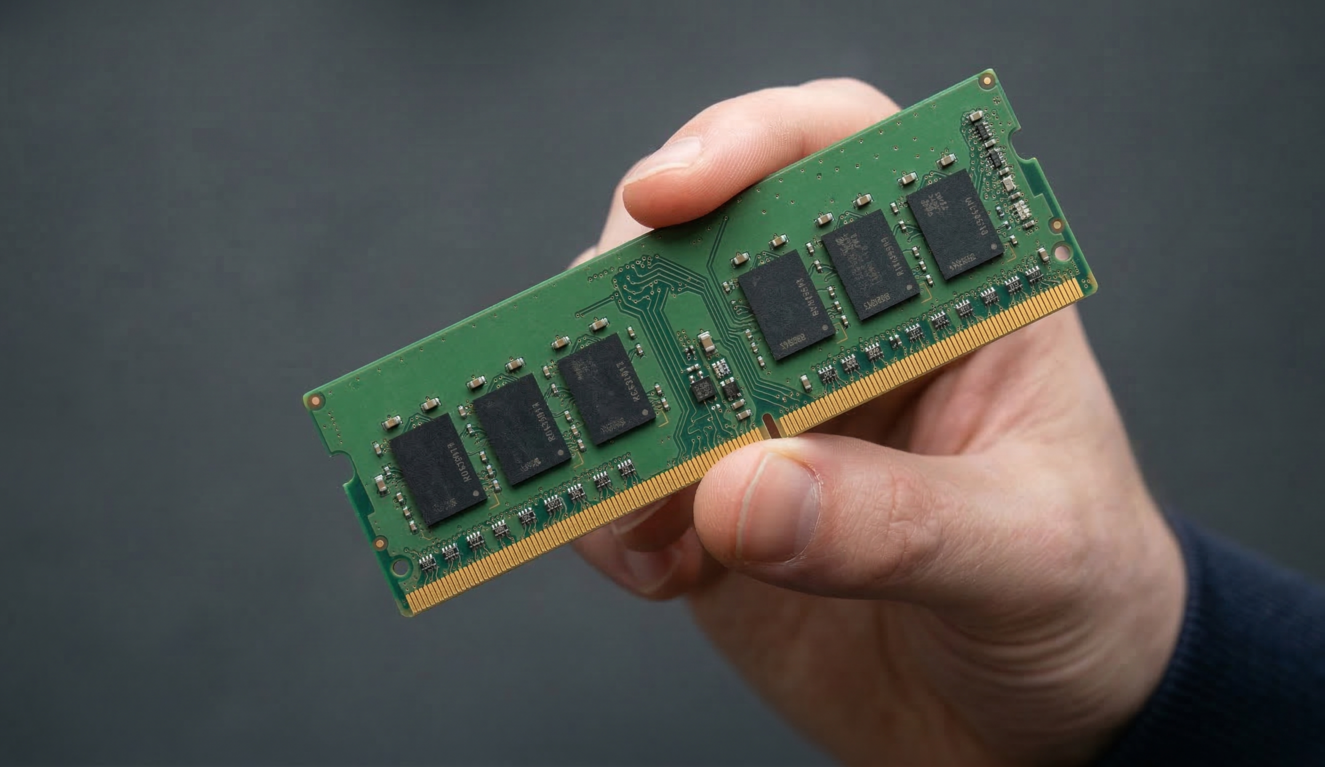
Is 8GB RAM Enough in 2026? The MacBook Neo Puts It to the Test!

“Is 8GB RAM enough in 2026?” It’s the most-asked laptop question of the year — and the answer has never been more complicated. Two forces are colliding simultaneously: Apple has just launched the £599 MacBook Neo, its cheapest laptop ever, with 8GB unified memory that cannot be upgraded; and a global DRAM shortage known as RAMageddon has pushed memory prices up over 170% year-on-year, quietly forcing Windows manufacturers to slide mid-range laptops back to 8GB configurations after years of progress toward 16GB as standard.
The result is a market where 8GB is being legitimised by Apple and undermined by Windows at exactly the same time. The honest answer: 8GB works for basic everyday tasks on a Mac in 2026, but it’s increasingly inadequate on Windows, and it won’t age well on either platform. Whether it’s enough for you depends on what you’re running, how long you plan to keep the laptop, and — crucially — whether you’re buying a Mac or a Windows machine.
The MacBook Neo: the best possible test case for 8GB RAM
The Apple MacBook Neo is the most important laptop released in years, not just because of the price but because of what it forces buyers to confront. At £599 — or £499 with Apple’s education discount — it is the cheapest Mac ever sold. It runs Apple’s A18 Pro chip and delivers single-core benchmark performance that, according to PC Gamer, beats every x86 PC processor in Geekbench 6. Battery life exceeds 13 hours in independent testing. The build quality is premium aluminium. And it ships with 8GB of unified memory. With no upgrade option. At any price.
Early reviews are nuanced rather than damning. Engadget found RAM usage hovering at 80–85% during multitasking stress tests, with macOS consuming roughly half of the 8GB simply to run itself before any apps were opened. Ars Technica found the Neo experiencing memory pressure “pretty much constantly” during normal use — not enough to make the machine miserable, but enough that switching to a 16GB MacBook Air “was a bit of a relief.” The Verge called the 8GB “totally adequate” for everyday life but noted the machine “does feel a little slower at the fringes.”
On MacRumors forums, real users report a split experience. One person described running fifty Safari tabs alongside Final Cut Pro and a SQL database without issues. An enterprise IT administrator said 2,500 employees use 8GB Macs for standard office work with no complaints. But Activity Monitor tells the truth: even moderate workloads push macOS into persistent yellow memory pressure — the system is actively compressing and swapping data to maintain responsiveness.
What the Neo handles comfortably with 8GB: browsing with 15–25 tabs in Safari, document editing, email, streaming, light photo editing, messaging. Where it begins to struggle: more than 30 browser tabs, multiple heavy applications open simultaneously, 4K video editing, local AI model work, and gaming — Cyberpunk 2077 reportedly would not launch at all. Ars Technica’s most useful observation was that the memory pressure problem “is not going to get better over time” as macOS and applications grow in their demands.
Why 8GB on a Mac genuinely differs from 8GB on Windows
This is not Apple marketing. The technical distinction is real — it just isn’t the complete answer Apple implies.
Apple Silicon uses Unified Memory Architecture (UMA), where the CPU, GPU, and Neural Engine share a single pool of high-bandwidth RAM integrated directly into the chip. On a standard Windows laptop, the CPU uses system RAM while a discrete GPU has its own separate VRAM. The same data often lives in both locations simultaneously. UMA eliminates that duplication, which means 8GB on a Mac genuinely stretches further than 8GB on a Windows laptop with a dedicated GPU — which effectively has 8GB system RAM plus 4GB GPU memory, 12GB total.
macOS also employs aggressive memory compression using its WKdm algorithm, compressing inactive memory pages in RAM before writing to the SSD. This is handled in hardware on Apple Silicon rather than burdening the CPU. Apple’s App Nap feature reduces idle application memory consumption. Safari uses roughly 30–40% less RAM than Chrome. These are real, measurable advantages.
The counterargument is equally real, however. In November 2023, Apple VP Bob Borchers claimed “8GB on an M3 MacBook Pro is probably analogous to 16GB on other systems.” Expert reaction was overwhelmingly sceptical — PC Gamer found that opening even a modest number of browser tabs on an 8GB Mac slowed the system noticeably in ways a 16GB Windows machine did not. Notebookcheck called the claim unjustifiable. Most tellingly, Apple itself contradicted its own position by making 16GB the baseline across all MacBook Air and MacBook Pro models starting in late 2024. The M5 MacBook Air, which launched alongside the Neo this month, starts at 16GB. The Neo is now the only Mac Apple sells with 8GB — an outlier in its own lineup.
UMA also carries a structural downside. Because unified memory serves as both system RAM and GPU memory, graphically demanding tasks consume from the same limited 8GB pool. A Windows laptop with 8GB system RAM and a 4GB discrete GPU has more total memory for mixed workloads than an 8GB Mac. The Neo’s 60GB/s memory bandwidth is less than half the MacBook Air M5’s 153GB/s — meaningful for any GPU-accelerated work.
The honest summary: 8GB on a Mac is better than 8GB on Windows, but it is not equivalent to 16GB on a PC. It is 8GB managed more intelligently.
RAMageddon is reshaping what manufacturers can afford to sell
The reason this question matters so urgently in 2026 is not the MacBook Neo alone. The global DRAM crisis has fundamentally disrupted what manufacturers can offer at any given price point.
AI datacentres operated by OpenAI, Google, Microsoft, Meta, and Amazon are consuming extraordinary quantities of high-bandwidth memory. Samsung, SK Hynix, and Micron — the three companies controlling over 90% of global DRAM production — have pivoted manufacturing capacity toward higher-margin enterprise memory products. Every wafer allocated to an AI accelerator is a wafer denied to laptop DDR5. As we covered in our article on why laptop prices are rising in 2026, DRAM contract prices rose 171.8% year-on-year through 2025, with TrendForce reporting a further 105–110% quarter-on-quarter surge in Q1 2026 alone — the largest single quarter increase ever recorded.
HP’s CFO disclosed that memory and storage jumped from roughly 15–18% of a laptop’s bill of materials to approximately 35% in a single quarter. Dell’s COO said he had “never seen memory-chip costs rise this fast.” Intel CEO Lip-Bu Tan confirmed there would be “no relief until 2028.”
The practical consequence for UK buyers: mid-range Windows laptops that were trending toward 16GB as standard are being de-specced back to 8GB to maintain price points. PCWorld cited a TrendForce analyst warning that “mid-range laptops may slide back to 8GB RAM” as manufacturers absorb cost increases. Wccftech reported that high-RAM configurations are being made “unaffordable” deliberately to push buyers toward lower-memory models at acceptable price points. At John Lewis, 32 laptops currently list with 8GB RAM — spanning Acer, HP, ASUS, Lenovo, Apple, and Samsung. Almost every laptop under £500 ships with 8GB. The transition to 16GB typically happens between £500–£600, at prices already inflated by the shortage. The typical UK uplift from 8GB to 16GB on comparable Windows models is £100–£200, and that gap is widening.
This is laptop shrinkflation. Gartner analysts project the sub-£400 entry-level PC segment will disappear entirely by 2028 as memory costs feed through. The 8GB you see on a £499 Windows laptop in March 2026 is not 8GB chosen for your benefit — it is 8GB chosen because 16GB would require raising the price or crushing the margin.
What the experts actually say: a clear fault line
On Windows laptops, expert consensus is consistent and clear: 8GB is functional but no longer recommended for new purchases. Every major outlet — TechRadar, The Verge, Tom’s Guide, Notebookcheck, SlashGear — lands in the same place. The recommended minimum for a new Windows laptop in 2026 is 16GB.
SlashGear specifies that 8GB handles email, messaging, streaming, and basic document editing, but falls short for Adobe Creative Suite (which recommends 16GB for Photoshop, 32GB for Premiere Pro), local AI work, and modern gaming where 16GB is the floor for the vast majority of 2026 titles. Microsoft’s own guidance, published in December 2025, states that 4–8GB covers “basic tasks such as web browsing, working with documents, or email” but that gaming and creative work at 8GB is “challenging.”
The most structural data point: Microsoft’s Copilot+ PC specification mandates a minimum of 16GB DDR5 or LPDDR5. No 8GB laptop qualifies for Copilot+ certification. With Microsoft positioning Copilot+ as the future of Windows — exclusive AI features, Recall, enhanced Studio Effects, on-device Live Captions — the 8GB Windows laptop is being architecturally excluded from the platform’s forward direction. TechRadar was blunt: 8GB “is looking overly lean for my liking these days — especially through the lens of any kind of future-proofing.”
Where genuine disagreement exists is on longevity and the Mac side. One MakeUseOf writer documented five years of productive use on an 8GB M1 MacBook Air for browser-based work, arguing that high Activity Monitor readings do not indicate a problem — an operating system is supposed to use available RAM for caching. This is technically accurate. The question is whether there is headroom for unexpected demands, and on 8GB there increasingly is not.
The specific UK buying decision: Neo base model or upgrade?

For UK buyers considering the MacBook Neo, the decision is more straightforward than the broader debate might suggest. Both the £599 base model (256GB storage) and the £699 upgrade (512GB storage) ship with identical 8GB RAM — there is no 16GB option at any price. The £100 you spend upgrading buys double the storage, Touch ID (absent on the base model, which only has a Lock Key), and a backlit keyboard.
The 512GB model is the stronger purchase on two counts. Storage matters more than it usually would on this machine because a full 256GB SSD will perform noticeably worse under memory pressure — macOS relies on fast SSD swap when RAM is compressed, and a drive near capacity slows that process. Touch ID is also a meaningful daily convenience that the base model genuinely lacks. At £699, the Neo still undercuts the MacBook Air M5 by £400.
For university students, the Neo at £499 education pricing is genuinely compelling for light workloads. For anyone with more demanding requirements — studying computer science, working with creative software, planning to keep the laptop beyond three or four years — the MacBook Air M5 at £1,099 offers 16GB RAM, 2.5 times the memory bandwidth, Thunderbolt 4 ports, a wider-gamut display, and far more comfortable headroom. Ars Technica’s warning is the one sentence every Neo buyer should read before purchasing: the memory pressure problem “is not going to get better over time.”
For Windows laptops, the guidance is simpler: do not buy 8GB in 2026 if you can avoid it. The £100–£200 premium for 16GB on a Windows machine is worth paying. If budget forces the choice, consider a quality refurbished laptop with 16GB — as we explored in our guide to laptop screen replacement costs and the broader refurbished market argument, machines like the Lenovo ThinkPad T14 and Dell Latitude 5420 offer 16GB configurations at prices that undercut new 8GB Windows alternatives.
The verdict
On a Mac: 8GB unified memory works in 2026 for light to moderate everyday use. The MacBook Neo is the best possible version of an 8GB laptop. It is comfortable for students and general users with calibrated expectations. It is not comfortable for anyone who works with creative software, runs complex workflows, or plans to keep their machine beyond four years. If you can stretch to the MacBook Air M5 and its 16GB, you will not regret it.
On Windows: 8GB is functional in 2026 but no longer adequate for confident new purchases. Windows 11’s own resource requirements, Chrome’s memory appetite, Microsoft’s Copilot+ specification, and the general trajectory of software all point toward 16GB as the practical baseline. The only reason manufacturers ship 8GB Windows laptops is cost — RAMageddon has made 16GB genuinely difficult to include at lower price points. That context explains the spec, but it does not justify accepting it if you have any alternative.
The broader picture: Two converging pressures — Apple legitimising 8GB with a landmark product and RAMageddon forcing manufacturers back toward 8GB — are creating a temporary illusion that 8GB is more acceptable than it actually is. It is enough for today’s basic workloads. It is not future-proof. The relief analysts expect in 2027–2028 will eventually push 16GB back to mainstream price points. Until then, buy 16GB where you can, be honest about your needs, and treat 8GB for what it is in 2026: a compromise dictated by market conditions rather than a ceiling set by your actual requirements.
I have spent years working in IT infrastructure and reviewing technology for British buyers. Affiliate relationships with Amazon do not influence scores or editorial assessments on this site.