ASUS V16 V3607VM Analysis: RTX 5060, Real Limits
The Blunt Verdict
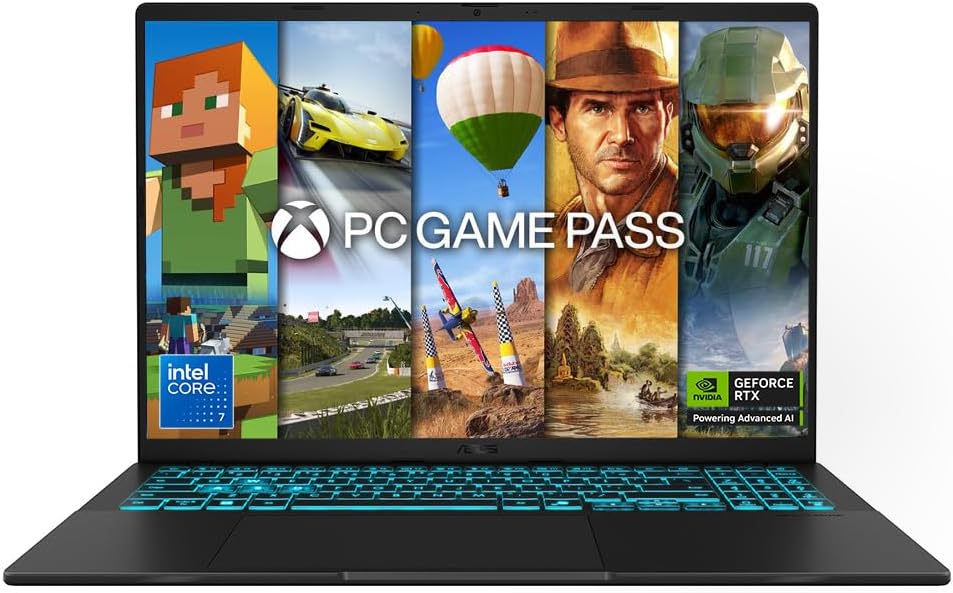
The ASUS V16 V3607VM is a budget gaming laptop with a genuinely headline-grabbing GPU — the NVIDIA GeForce RTX 5060 — stuffed into a slim, light chassis that weighs just 1.95kg. That combination is rare at this end of the market. The catch, and it’s a real one, is that the GPU is running at a constrained 80W TDP (combined CPU and GPU), which puts a ceiling on what it can actually do. You’re not getting desktop-class RTX 5060 throughput. You’re getting a mobile-optimised, thermally limited version of it. That distinction matters enormously for how you frame expectations.
The supporting specs are decent without being exciting. 16GB DDR5 RAM, a 1TB PCIe 4.0 NVMe SSD, an Intel Core 7 240H processor with 10 cores and boost to 5.2GHz, and a 16-inch WUXGA 1920×1200 panel running at 144Hz. On paper that looks strong for the money. In practice, buyer feedback tells a more nuanced story — the GPU is capable, the screen is dim and washed out, and the build quality is unmistakably plastic.
Buy it if you’re a light-to-mid gaming user who wants modern GPU architecture on a tight budget and can tolerate a dim screen and fan noise. Avoid it if you need colour-accurate output, you’re planning intensive creative work, or you want a laptop that feels sturdy. The ASUS V16 V3607VM earns its place in the budget gaming category, but you need to go in clear-eyed about its limits.
See the full listing and buyer Q&As for the ASUS V16 V3607VM on Amazon.

Pros and Cons
Pros
- RTX 5060 with GDDR7 VRAM is a genuinely modern GPU for the money — DLSS 4 support extends its effective gaming life
- One spare DDR5 SO-DIMM slot means RAM is upgradeable to 32GB, which is rare and welcome at this price point
- 144Hz refresh rate on a 16:10 WUXGA panel gives noticeably smoother gaming than 60Hz budget alternatives
- At 1.95kg, it’s lighter than most gaming laptops carrying a dedicated GPU — genuinely portable by gaming laptop standards
- MYASUS app quiet mode demonstrably reduces fan noise according to multiple buyers
Cons
- Display is dim and lacks colour accuracy — multiple buyers flag this; rules it out for design or creative work
- Plastic construction feels cheap — the chassis flex and keyboard sponginess are consistent complaints from hands-on buyers
- 80W combined TDP is a significant constraint — GPU performance sits meaningfully below a full-power RTX 5060
Spec Breakdown
- Model: ASUS V16 V3607VM
- CPU: Intel Core 7 240H — 10 cores, 16 threads, up to 5.2GHz, 24MB cache
- RAM: 16GB DDR5 (one additional SO-DIMM slot, upgradeable to 32GB)
- Storage: 1TB M.2 NVMe PCIe 4.0 SSD
- GPU: NVIDIA GeForce RTX 5060 8GB GDDR7 (80W combined TDP)
- Display: 16-inch WUXGA 1920×1200, 144Hz, LED, 16:10 aspect ratio
- Battery: 63Wh Lithium-Ion
- OS: Windows 11 Home
- Weight: 1.95kg
- Ports: HDMI, DisplayPort, 3x USB (includes Ethernet via USB), Wi-Fi
- Connectivity: Wi-Fi 6 (802.11ax), Bluetooth, Ethernet
- Keyboard: Backlit, UK layout
- Webcam: Yes
Hardware & Performance Reality Check
The Intel Core 7 240H is a capable mid-to-high-end mobile processor — 10 cores, 16 threads, boosting to 5.2GHz. For daily tasks, gaming, and even light content work it’s more than adequate. It won’t bottleneck you in everyday use. The 16GB DDR5 RAM is the important caveat — it’s not soldered. There is a spare SO-DIMM slot, which means you can expand to 32GB later without binning the machine. That’s a genuine differentiator. If you’re running local AI models, heavy multitasking, or keeping Chrome open with 40 tabs while gaming, that upgrade path exists. One buyer running local LLMs flagged 16GB as tight but workable. For anyone who wants to understand how much RAM you actually need, the short answer here is: 16GB is fine for most, but the upgrade slot means you’re not stuck.
The 1TB PCIe 4.0 NVMe SSD is genuinely fast storage — sequential reads in the 5000MB/s range on good PCIe 4.0 drives. Games load fast, the OS feels snappy. No complaints expected there. The GPU is where it gets complicated. The RTX 5060 with 8GB GDDR7 looks excellent on a spec sheet. The reality is the 80W combined TDP — that’s 80 watts shared between CPU and GPU together, not 80 watts each. A full-power RTX 5060 laptop GPU sits closer to 115–140W. The power envelope here is constrained to keep the chassis thin and light, and that compression comes at a measurable performance cost. One returning buyer specifically called this out after comparing it unfavourably to an older, full-power RTX 4060. DLSS 4 helps bridge the gap — NVIDIA’s frame generation and upscaling tech is genuinely good and partially compensates for the raw throughput deficit — but it doesn’t fully close it. Check performance benchmarks for this GPU tier before committing.
In 2026 terms: student work and office tasks — no problem whatsoever. Light-to-mid gaming at 1080p with DLSS engaged — largely fine, buyers are reporting solid frame rates on GTA V and Stalker 2 at medium settings. Programming and development work — the CPU and RAM handle it comfortably. Video editing — possible for 1080p timelines, but the dim screen makes colour grading unreliable, and the power-constrained GPU slows export times compared to a full-power card. If professional video editing or colour work is on the agenda, the ASUS V16 V3607VM is the wrong tool — look at professional-grade options with proper display calibration instead.
One additional factor worth flagging: the port configuration is lean. Three USB ports total, with Ethernet delivered via USB adapter rather than a dedicated RJ-45 jack. Video output covers HDMI and DisplayPort. There’s no Thunderbolt mentioned in the data. For most gaming users this is fine; for anyone who needs a dense wired workflow, it’ll feel limiting.
Check the full spec sheet and buyer Q&As for the ASUS V16 V3607VM on Amazon.
Everyday Usability: Battery, Build & More
Battery life is, predictably, a weak point. The 63Wh cell is not small, but powering an RTX 5060 from battery alone is a fundamentally losing battle. Buyers consistently report keeping it plugged in during gaming. Light use — browsing, documents, video streaming — will get you a few hours, but don’t plan a full day away from a socket if you’re doing anything GPU-intensive. This isn’t a flaw so much as a physics problem: gaming laptops at this weight with this GPU simply aren’t going to last eight hours unplugged. The 150W charger that ships with it is another constraint — one buyer found the charger undersized relative to the GPU’s potential, which contributes to the power-limited performance picture. Fan noise is a genuine consideration — multiple buyers report the laptop gets loud under load. The MYASUS app’s quiet mode does help, and one buyer said it goes “extremely quiet” in that mode, but quiet mode will trade performance for noise reduction. The ASUS V16 V3607VM runs warm under sustained gaming, though no buyers reported thermal throttling in performance mode.

The 16-inch 1920×1200 144Hz display is a mixed story. The 16:10 aspect ratio and high refresh rate are genuinely useful. The brightness and colour saturation are not. Two separate buyers used the words “dim” and “washed out” independently. Indoors it’s fine. Outdoors or in bright rooms, it’ll frustrate you. The display panel type isn’t specified by ASUS in the listing data, but the buyer feedback points strongly toward a TN or lower-end IPS. This is not a display for colour-sensitive work. There is no touchscreen. The keyboard gets a mixed reception — the backlighting is a nice touch, but the key travel has been described as spongy, which is a real usability complaint for heavy typists. The trackpad is reportedly large but imprecise. The plastic chassis picks up fingerprints easily and doesn’t feel rigid — there’s some flex noted by buyers when the lid is under pressure. The webcam is present but no buyer has commented on quality, which usually means it’s adequate but not good. No fingerprint reader is mentioned in the spec data.
Lifespan & Future-Proofing
The chassis longevity is the weaker concern here. Plastic construction with reported flex in the lid and a keyboard that feels soft isn’t a recipe for five-plus years of daily punishment. Handle it with reasonable care and it’ll survive — throw it into bags carelessly and the hinge and lid integrity will degrade faster than a metal-chassis machine. Realistically, three to four years of careful use before build quality becomes a daily irritant. One buyer already flagged concern about screen durability under pressure from a snug laptop bag.
On spec longevity, the picture is considerably more optimistic. The RTX 5060 with DLSS 4 is a current-generation GPU in 2026 — it’ll handle mainstream gaming for at least three to four years before it starts feeling genuinely constrained at 1080p. The Core 7 240H has comparable staying power for everyday compute tasks. The RAM upgrade path to 32GB extends the useful life further, and the 1TB PCIe 4.0 SSD is sufficient for most users today. The single M.2 slot is a mild frustration — if you need more storage, you’re looking at external drives rather than a second internal NVMe. Wi-Fi 6 (802.11ax) future-proofs the wireless side adequately. The power-limited GPU is the spec that ages least gracefully — as game engines demand more raw throughput, the constrained TDP will show its ceiling sooner than a full-power card would. For anyone interested in what these specs actually mean in plain English, the summary is: solid for three to four years of gaming, longer for general use, limited by build quality before it’s limited by horsepower.
View current stock and availability for the ASUS V16 V3607VM on Amazon.
What Buyers Are Saying (And Potential Dealbreakers)
The ASUS V16 V3607VM holds a 4.0 out of 5 rating across 45 Amazon customer reviews. That’s a reasonable sample, though still relatively early in the product lifecycle. The split is broadly positive with a cluster of five-star reviews from gaming users and a handful of pointed two-star and one-star returns from buyers who felt the machine didn’t deliver on its headline promise.
The recurring praise: frame rates on demanding titles are holding up, lightweight chassis is genuinely appreciated, and the MYASUS app gives useful control over fan behaviour. Several buyers flag the performance-to-cost ratio as strong, particularly for mid-tier gaming. The AI and machine learning crowd are getting usable results from local LLMs and image generation workflows — not ground-breaking, but functional. One buyer ran Stalker 2 with weather mods at medium settings and reported mostly stable 90fps with only occasional drops.
The recurring complaints are harder to brush off. The screen is the most consistent disappointment — dim, washed-out, and not suitable for anything requiring colour fidelity. Build quality draws regular criticism; the laptop looks and feels inexpensive in a way that some buyers find genuinely off-putting. The 150W power brick has been called out as undersized. And there is one severe outlier — a buyer who experienced catastrophic software issues including a five-hour game download, inability to update drivers, and a reset process that stalled at 62%. That review resulted in a return. It’s a single data point, but worth knowing exists.
The dealbreakers to watch: if display quality matters to you at all, this machine will disappoint. If you’re expecting full-power RTX 5060 performance based on the spec sheet alone, the 80W TDP is a rude awakening. If you want something that feels premium in hand, look elsewhere — even at the premium gaming end of the market you’d be paying for build quality the ASUS V16 V3607VM simply doesn’t offer.
Buyer Highlights
“I tested GTA on all high settings and was hitting 60 to 100fps with Discord and Chrome running in the background — for this price that’s amazing.” — Worth knowing if mid-tier open-world gaming is your primary use case.
“I’ve been running local LLMs and ComfyUI image generation — it’s perfectly capable, not going to run the latest heavyweight models but there’s plenty it can handle.” — Relevant if you’re experimenting with AI workflows on a budget.
“In quiet mode via the MYASUS app it goes extremely quiet — the noise problem I had at first basically disappeared.” — Useful to know before assuming the fans are unmanageable.
“The screen is dim and washed out — games don’t look great and you certainly can’t use it for design or creative work.” — The most consistent display complaint across returning buyers; treat it as a confirmed limitation, not an edge case.
“It’s light and comfortable but the plastic covering is prone to fingerprints and I’m not sure about screen durability if it sits in a snug case.” — Worth bearing in mind if you’re rough on your gear or transport it daily.
Who Should Buy It (And Who Shouldn’t)
Buy If
- You want current-generation GPU architecture for light-to-mid gaming and can accept the power-limited performance ceiling
- Portability matters — at 1.95kg this is genuinely lighter than most gaming laptops, and the weight saving is real
- You plan to upgrade RAM later — the spare SO-DIMM slot means 32GB is an option without replacing the machine
- You’re a student or casual user who games in the evenings and needs a single machine that covers both workloads
Avoid If
- Display quality matters — the dim, washed-out screen is a confirmed and consistent problem, not a one-off complaint
- You’re expecting full RTX 5060 performance based on the GPU name alone — the 80W TDP means real-world output is meaningfully lower than a full-power card
- You need a laptop that feels structurally solid — the plastic chassis with reported flex is not for buyers who value build quality
The Bottom Line
The ASUS V16 V3607VM is a machine that earns its place for the right buyer and disappoints everyone else. The GPU is real, the CPU is capable, the RAM is upgradeable, and the weight is genuinely low for a gaming laptop. But the power-limited GPU, dim display, and plastic construction are not marketing spin — they’re confirmed by multiple buyers who returned the machine or graded it down specifically for those reasons. Go in knowing that the RTX 5060 here is not a full-fat card, the screen won’t impress anyone who cares about picture quality, and the build won’t survive abuse. If you’re a light-to-mid gamer on a tight budget who prioritises specs over tactile quality and can manage your expectations around display brightness, there’s a decent machine here. If any of the caveats above are dealbreakers for your use case, your money is better spent elsewhere — the buying guide covers what to prioritise at different budgets and use cases before you commit.
At LaptopAdvisorOnline, our methodology is built on data transparency rather than simulated hands-on testing. We rigorously analyse official manufacturer specifications and aggregate verified customer sentiment to provide objective, fluff-free buying advice that helps you cut through the marketing jargon.
As an Amazon Associate, I earn from qualifying purchases.
Browse by Specification
Looking for something specific? Browse our analyses by hardware and feature below, or check all laptop analyses in the Best Premium Gaming Laptops category archive.
[AMD Processor Laptops] — [Intel Processor Laptops] — [16GB RAM Laptops] — [32GB RAM Laptops] — [Dedicated Graphics] — [Long Battery Life] — [Lightweight Laptops] — [Student Laptops]
Browse by Screen Size
[13-inch Laptops] — [14-inch Laptops] — [15-inch Laptops] — [16-inch+ Laptops]