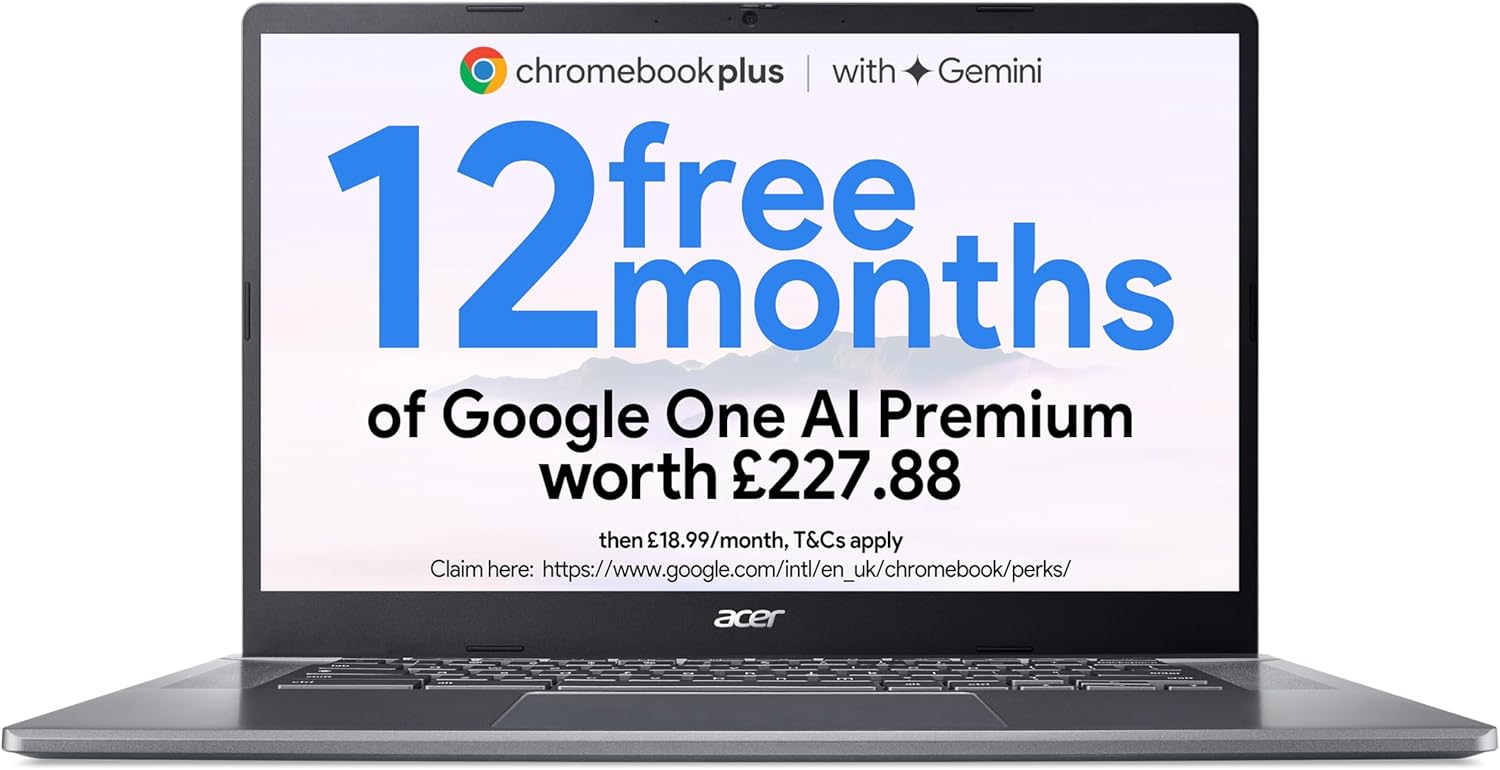
Acer Chromebook Plus 515 CB515-2H Analysis: ChromeOS Done Right
The Blunt Verdict
The Acer Chromebook Plus 515 CB515-2H is a straightforward machine for a straightforward audience: people who live in a browser, want something fast to boot, and aren’t interested in Windows headaches. It runs ChromeOS on a 12th Gen Intel Core i5-1235U, pairs it with 8GB of LPDDR4 RAM, and gives you a 15.6-inch Full HD screen to work with. For that audience, it does the job well. For anyone expecting a Windows replacement with full desktop app support, it doesn’t, and that’s a deliberate design choice, not a flaw.
The headline specs are respectable for a Chromebook. The i5-1235U is a proper 12th Gen Alder Lake chip — not a cut-down Celeron or Pentium — which puts this firmly above the cheap-and-sluggish end of the Chromebook market. 256GB SSD storage is generous for ChromeOS, which doesn’t need much room. The display resolution sits at 1920 x 1080 with an anti-glare coating, the battery is rated at 56 Wh, and connectivity includes Wi-Fi 802.11ac and Bluetooth 5.0. Nothing here is trying to be something it isn’t.
Buy this if you want a well-specced Chromebook with a large screen for web browsing, Google Workspace, and light document work. Avoid it if you need Windows applications, offline desktop software, or anything approaching video editing or gaming. ChromeOS is the product here — if that OS works for your needs, this is a solid option in the budget laptop space. If it doesn’t, no amount of good hardware will fix that.
See the Acer Chromebook Plus 515 CB515-2H listed on Amazon before reading further.
Pros and Cons
Pros
- Genuine i5-1235U chip means snappy everyday performance — well above the underpowered Celerons that dominate cheap Chromebooks
- 256GB SSD is a healthy amount of local storage for a ChromeOS machine that typically runs lean
- Backlit keyboard confirmed by multiple buyers — useful and not always present at this end of the market
- 15.6-inch Full HD anti-glare display with narrow bezels makes for a comfortable daily workspace
- MIL-STD-810H durability rating adds some reassurance for buyers who aren’t precious about their hardware
- ChromeOS updates silently in the background — zero maintenance overhead for the user
Cons
- RAM is not upgradeable — 8GB is what you get, permanently, with no expansion path
- Port selection is limited: essentially one USB-A, one USB-C, HDMI, and a headphone jack — no Ethernet built in
- Real-world battery life sits closer to 6–7 hours according to buyers, not the 10 hours Acer advertises
Spec Breakdown
- Model: Acer Chromebook Plus 515 CB515-2H (NX.KNUEK.006)
- CPU: Intel Core i5-1235U (12th Gen, Alder Lake-U, up to 4.4GHz)
- RAM: 8GB LPDDR4
- Storage: 256GB SSD (SATA)
- GPU: Intel Integrated Graphics (shared memory)
- Display: 15.6-inch, 1920 x 1080 Full HD, anti-glare LCD, touchscreen
- Battery: 56 Wh lithium-ion, rated 10 hours
- OS: ChromeOS
- Weight: 2.72kg
- Ports: USB 3.2 Type-A, USB-C (video out), HDMI, headphone jack
- Connectivity: Wi-Fi 802.11a/b/g/n/ac, Bluetooth 5.0
- Keyboard: Backlit QWERTY
- Camera: Built-in HD webcam with privacy slider
Hardware & Performance Reality Check
The Intel Core i5-1235U is the right chip for this machine. It’s a 10-core Alder Lake processor — two performance cores, eight efficiency cores — and it handles web browsing, streaming, Google Docs, Sheets, and a genuinely large number of open tabs without breaking a sweat. Buyers confirm this directly: one notes it was “very fast, easily managing loads of tabs open at the same time.” The 8GB of LPDDR4 RAM supports that comfortably for typical ChromeOS workloads. The bad news: it’s soldered. There is no slot to upgrade later, and the spec sheet confirms the maximum memory size is 8GB. If you want to understand why that matters long-term, the RAM guidance is worth a read. For light users, 8GB is fine now. Whether it remains fine in five years is a different conversation.
The 256GB SSD runs over a SATA interface rather than NVMe, which means it’s not as fast as the storage in pricier machines — but ChromeOS doesn’t demand NVMe speeds, and day-to-day you won’t notice the difference. Local storage matters less here anyway since ChromeOS is built around cloud-first workflows. Graphics are fully integrated — Intel’s shared GPU handles video playback and browser rendering without issue, but this is not a machine for GPU-accelerated tasks. No gaming worth speaking of, no video editing, no 3D work. If you need any of that, you’re looking at the wrong category entirely — the budget gaming segment starts somewhere else.
For 2026 use cases: student work and essay writing, yes. Office 365 via browser, yes (buyers confirm it works well with a subscription). Programming in a browser-based environment like Replit, yes. Local Python or Java development, limited. Video editing, no. Photo editing via Google Photos with AI tools, genuinely decent. Gaming, no. This is a machine optimised for a specific workflow, and within that workflow it’s more than capable. Check the performance benchmarks guide if you want to understand where the i5-1235U sits in the broader processor landscape.
One connectivity point worth flagging separately: the spec data lists Wi-Fi 802.11ac (Wi-Fi 5) rather than Wi-Fi 6 or 6E. The product description mentions Wi-Fi 6E, but the specification data for this specific ASIN confirms ac-band wireless only. There is no built-in Ethernet port — if you need a wired connection, you’ll need a USB-C adapter. Check the ports guide if you’re uncertain what to expect from a machine with this connectivity profile.
Browse the full spec sheet and buyer Q&As for the Acer Chromebook Plus 515 CB515-2H on Amazon.
Everyday Usability: Battery, Build & More
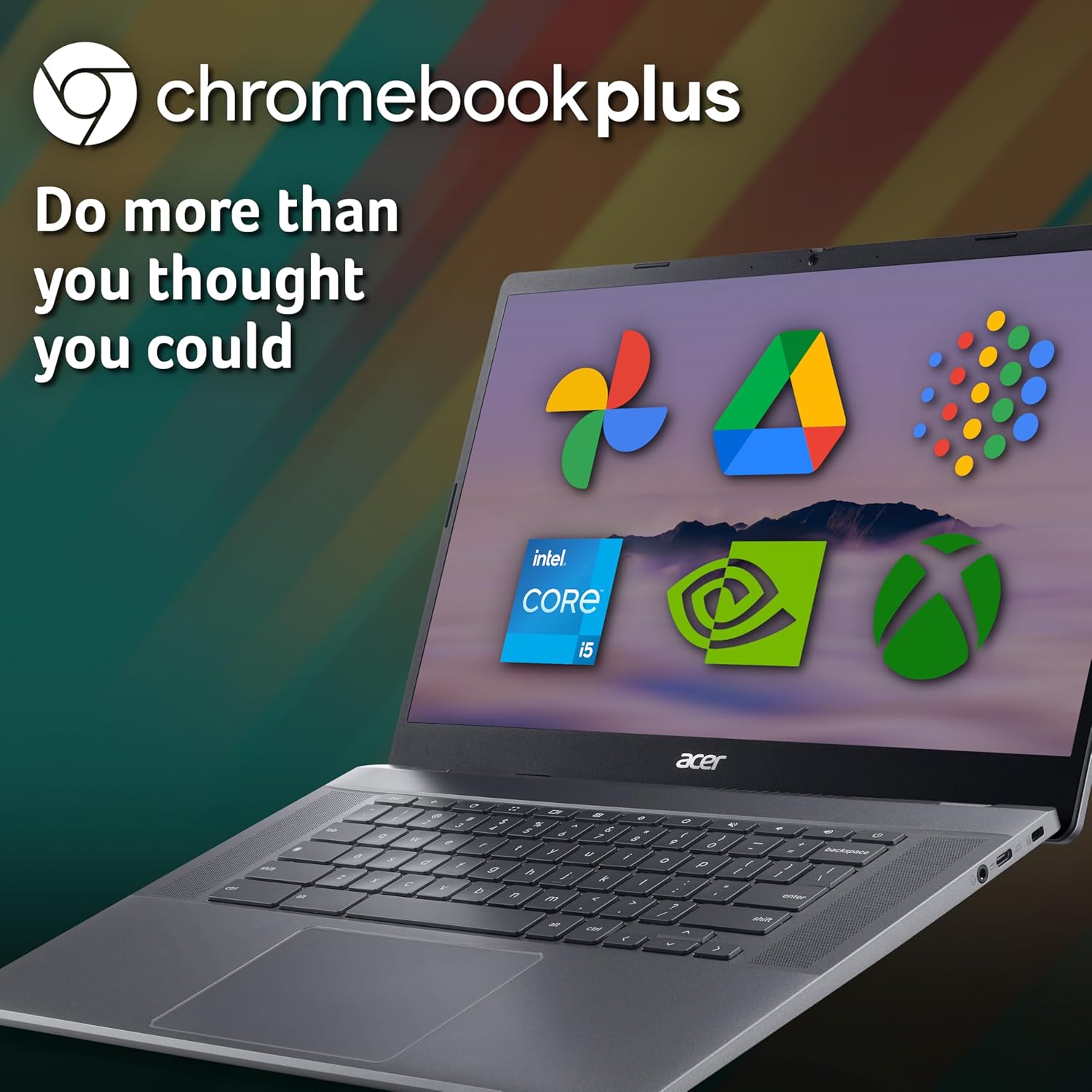
At 2.72kg, this isn’t a machine you’ll want to carry across a campus every day. It’s a desk-based or kitchen-table laptop that happens to be untethered, not a commuter machine. The chassis carries the MIL-STD-810H durability rating, which gives it some resistance to drops and temperature changes — that’s a genuine differentiator at this price point. The iron/grey finish is functional rather than flashy. The 15.6-inch display at 1920×1080 with anti-glare coating is well-regarded by buyers: one describes it as “bright and clear,” and the narrow bezel design means more screen, less frame. The touchscreen is capacitive and present — useful if you’re used to tablet-style interaction, though not everyone will use it. Display panel types matter here — this is an LCD, not IPS confirmed explicitly, so colour accuracy for creative work is a question mark.

Battery life is the headline disappointment. Acer quotes 10 hours; at least one buyer clocked 6–7 hours with backlit keyboard on and active browsing. That’s still enough for a typical working day at reduced brightness, but don’t plan on an all-day session away from a plug without managing your settings. The backlit keyboard gets positive mentions from multiple buyers — good travel, responsive, and the backlighting itself works properly. The trackpad is large, though the lack of a traditional right-click is a ChromeOS characteristic that catches Windows migrants off guard (two-finger tap handles it). Audio comes from two upward-facing speakers positioned at either end of the keyboard — buyer feedback is generally positive, described as “good” rather than thin. The built-in webcam includes a physical privacy slider, which is a small but appreciated detail for video calls. There is no fingerprint reader mentioned in the specs or reviews.
Lifespan & Future-Proofing
The MIL-STD-810H chassis certification suggests this should physically survive normal use for several years without structural issues. Chromebooks historically hold up well mechanically — fewer moving parts, no spinning drives, a simpler OS that doesn’t accumulate the kind of software bloat that slows Windows machines down over time. Realistically, the hardware should remain physically functional for five-plus years without drama.
Spec longevity is the trickier question. 8GB of soldered RAM with no upgrade path means you’re locked in permanently. For current ChromeOS workloads that’s adequate, but web applications are not getting lighter. Google has committed to ChromeOS support timelines for certified devices, and the CB515-2H should be covered for several years from its 2023 release. Beyond that, you’re on borrowed time. The i5-1235U is a capable enough chip that it won’t feel embarrassingly slow by 2026 for typical browser-based tasks, but the RAM ceiling will become the constraint before the CPU does. No NVMe storage and no RAM expansion mean there is no upgrade path when performance starts to feel sluggish — you replace the machine rather than upgrade it. Factor that into your decision if you’re thinking about this as a five-year purchase.
Check current availability for the Acer Chromebook Plus 515 CB515-2H on Amazon.
What Buyers Are Saying (And Potential Dealbreakers)
The Acer Chromebook Plus 515 CB515-2H holds a rating of 4.4 out of 5 across 42 Amazon customer reviews. That’s a reasonably healthy sample for a considered verdict, though it sits on the lower end of what I’d want for full confidence. The pattern across reviews is consistent: buyers who understood they were buying a Chromebook are satisfied; buyers who wanted a Windows laptop and tried to use this as one are less so.
The most recurring praise is for boot speed and general snappiness — multiple buyers from different purchase dates note that it loads quickly and handles multitasking well for everyday tasks. The keyboard, display, and build quality all get positive mentions. Setup is described as straightforward, particularly for existing Android and Google account users. One buyer migrating from Windows 10 found the transition manageable with minor adjustment; another using it for business web tasks found it fit for purpose almost immediately.
The recurring complaints are battery life and the port situation. One buyer specifically flags that the forward-facing speakers make the keyboard feel narrow — that’s a physical layout trade-off worth knowing about. Another notes the grey keyboard with white lettering can be harder to read in certain lighting, though they still consider the machine usable. Battery expectations need managing: the 10-hour claim is not what real users are seeing with everyday use, particularly with backlighting enabled.
The ChromeOS learning curve also appears as a mild but consistent theme. Right-click behaviour, offline app limitations, and the absence of native desktop Microsoft Office are mentioned by multiple buyers as things to adjust to. None of them walked away unhappy, but they do flag the adjustment period as real. If you want straight answers on what ChromeOS can and can’t do before you commit, the laptop buying guide covers OS trade-offs in plain English.
Buyer Highlights
“It boots up in a jiffy and you can get on with tasks almost instantly.” — Repeated across multiple reviews; boot speed is the standout practical win for buyers coming from slow Windows machines.
“Very fast, easily managing loads of tabs open at the same time — the i5 makes a real difference.” — Relevant if you’re a heavy tab opener, which most casual users are.
“Battery life is more like 6 to 7 hours rather than the 10 hours advertised.” — Dealbreaker territory for anyone planning full-day untethered use; plan around a 7-hour ceiling with normal settings.
“Setup was a breeze, and all my information transferred instantly without problems.” — Useful for non-technical buyers worried about migration from an older device.
“It’s not a Windows laptop with all its functionality — but if you accept that, there’s a lot to recommend it.” — The most honest one-line summary from the buyer pool.
Who Should Buy It (And Who Shouldn’t)
Buy If
- You live in Google Workspace — Docs, Sheets, Gmail, Drive — and want a fast, low-maintenance machine for that workflow
- You’re switching away from a slow Windows 10 machine and don’t need legacy desktop apps; the performance jump will be immediately noticeable
- You want a large-screen Chromebook with a proper processor — the 15.6-inch display and i5 chip put this well above the typical underpowered Chromebook crowd
- You’re a student who uses web-based tools and wants a machine that just works without IT overhead
Avoid If
- You need Microsoft Office desktop apps, local software installations, or any application that doesn’t run in a browser or on the Android/Linux layer of ChromeOS
- You’re buying this as a long-term investment expecting to upgrade RAM or storage later — the 8GB soldered RAM is a permanent ceiling with zero expansion path; if you’re comparing against upgradeable Windows options, look at the mid-range laptop alternatives instead
- You need reliable all-day battery away from power — real-world figures suggest you’ll want a charger nearby after 6–7 hours
The Bottom Line
The Acer Chromebook Plus 515 CB515-2H is a well-executed machine for a specific type of user. The i5-1235U gives it a performance edge over most of its Chromebook competition, the build quality is solid, and ChromeOS delivers exactly what it promises: fast boot, zero maintenance, and a clean browsing experience. The limitations are real — soldered RAM, modest port selection, and battery life that doesn’t match the marketing — but none of them are surprises if you go in with accurate expectations. Know what ChromeOS is, know what it isn’t, and this becomes an easy call for the right buyer.
Find the Acer Chromebook Plus 515 CB515-2H on Amazon to make your decision.
At LaptopAdvisorOnline, our methodology is built on data transparency rather than simulated hands-on testing. We rigorously analyse official manufacturer specifications and aggregate verified customer sentiment to provide objective, fluff-free buying advice that helps you cut through the marketing jargon.
As an Amazon Associate, I earn from qualifying purchases.
Browse by Specification
Looking for something specific? Browse our analyses by hardware and feature below, or check all laptop analyses in the Best Budget Laptops category archive.
[AMD Processor Laptops] — [Intel Processor Laptops] — [16GB RAM Laptops] — [32GB RAM Laptops] — [Dedicated Graphics] — [Long Battery Life] — [Lightweight Laptops] — [Student Laptops]
Browse by Screen Size
[13-inch Laptops] — [14-inch Laptops] — [15-inch Laptops] — [16-inch+ Laptops]